
Welcome to Prime Factors where we review each UK Prime Minister from Robert Walpole to Keir Starmer. We discuss their biography, highs and lows, and then rate them on a scale designed by a 10-year old before awarding the ultimate prize: Are they ”Known” or an ”Ice Cream Cone”?
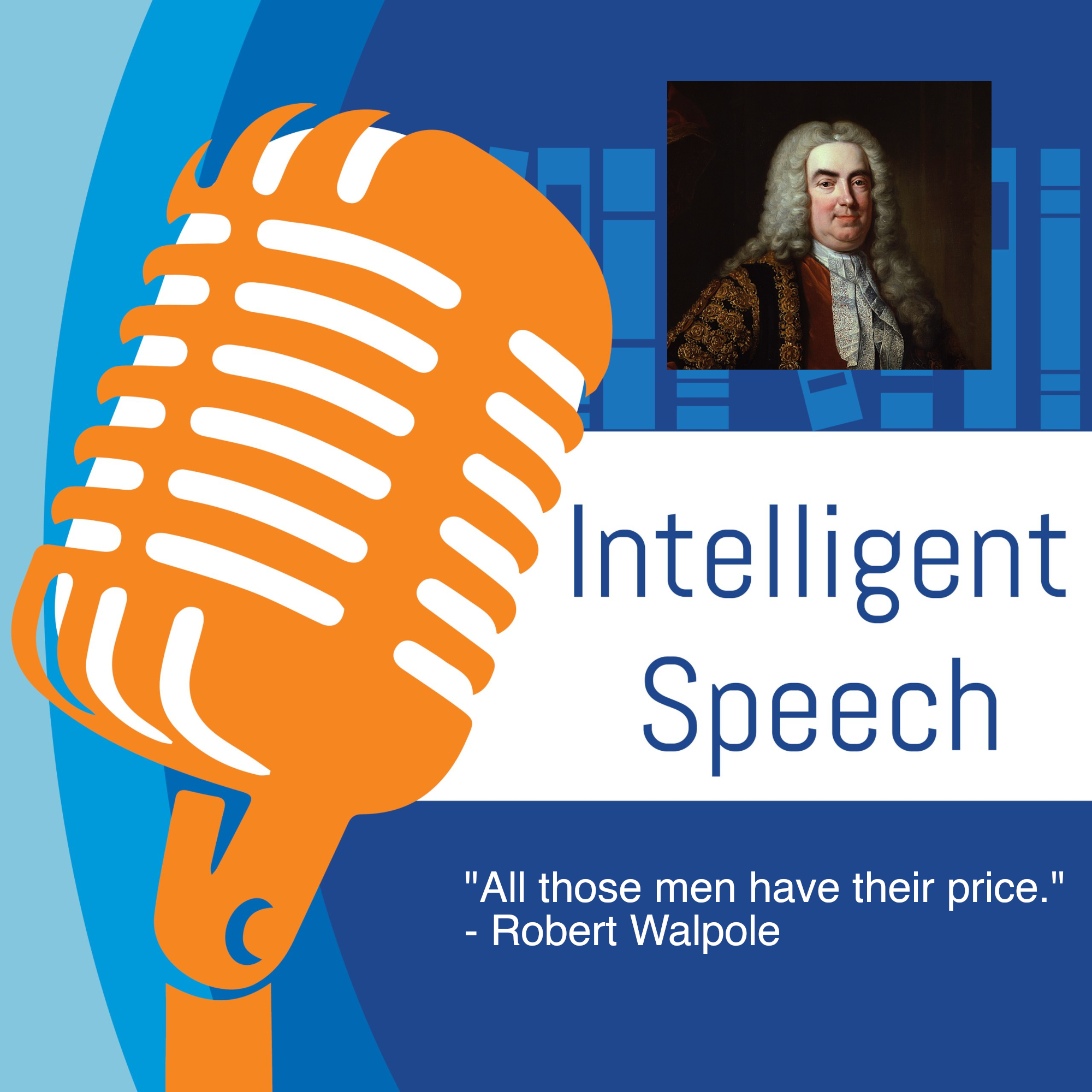
Prime Lies: Robert Walpole (Intelligent Speech 2025 Presentation)
Link:
Prime Lies: Robert Walpole (Intelligent Speech 2025 Presentation)
Episode Transcript
Abram: Welcome to Prime Factors.
Prime Lies: Robert Walpole
Parliament: Hip hip hooray! Hip hip hooray! Hip hip hooray!
Abram: Hello and welcome back to Prime Factors. I'm Abram, and I'm not here with my dad. We usually review all the British prime ministers from Robert Walpole to Keir Starmer, but this is a special episode that dad presented at the Intelligent Speech 2025 conference. I wasn't in that episode.
Abram: I'm gonna let dad present, but every once in a while, somehow he forgot that we're an audio-only podcast even though we've been around for a year, and I'll hop in to tell you what you're supposed to be seeing.
Abram: Don't forget that you can find us on Apple Podcasts, Spotify, YouTube, and www.primefactorspodcast.com. We're also on Facebook and BlueSky. If you enjoy listening, please like, subscribe, comment, and review.
Joe: What I'm going to talk about today are the lies of Robert Walpole, both around Robert Walpole and some of the lies and deceptions that he committed himself. Now, you being a good British person. You might notice I speak with this weird American accent. I'm actually a Yinzer. I'm from Western Pennsylvania, but most of that accent has gone as I have lived now in Boston for 20 years.
Joe: You might not be as familiar with British prime ministers certainly as I am, or as I am not as an American. I've learned a lot of this recently. My son got me into this because he was memorizing all of the prime ministers and wanted me to tell him more. So this wasn't my area, but it is now.
Joe: Anyway, to talk about Robert Walpole, we need to set the scene. And that scene is of course the Hanoverians and old story for some, but the story of how they got a whole bunch of Germans that didn't really speak English and really needed the power and the value of a prime minister, right? Really begins with James II. He was Catholic. He wasn't even pretending to not be Catholic, unlike his dad.
Joe: But good news, he doesn't have any Catholic kids. He has two Protestant kids. Therefore, when he dies, he was 52 at this point, we're going to have a Protestant succession and all is going to be great. Well, unfortunately, even 52-year-old men are capable of doing the thing that causes children to happen. I know, shocking. It is true. That part isn't a lie.
Joe: So he ended up having a kid. This is James Stuart. And almost immediately after he had a kid, he had a Glorious Revolution, which, well, good for him, I suppose. It turns out that Parliament was really unkeen on this idea of having a Catholic succession. So they invite William and Mary to come in and do their thing. Get Mary II, William III.
Joe: And then from there, Parliament was good enough and kind enough to pass some laws that would prohibit further Catholic monarchs with the aim for Sophia of Hanover, this tiny little electorate in Germany, to be potentially the next queen. But after we go from Mary to William to Queen Anne, they, um, hmm, Sophia was dead. And unfortunately, that means that we get George I as the king.
Joe: And of this presentation today, we're mostly going to be staying between 1720 and 1760. And so we have three Hanoverians: George I, George II, or George III. But you may know them better, as I do, as the sad one, the bad one, and the mad one.
Joe: By the way, if you are an American watching this, Horrible Histories is amazing. You gotta get it on YouTube, and you can get it on, like, Apple TV. You can find it. It is not a thing here, but it is so good, and I highly recommend finding it. My son, I have bought him several of the Horrible Histories books, and he's quite enamored with Horrible Histories.
Joe: Anyway, the story of Robert Walpole starts with a stock market crash. Nothing leads to a seizure of power like a crisis. We had something called the South Sea Company. It was a trading company, ideally for trading to Spanish colonies, but they also sort of dabbled in slavery. It was, you know, let's not talk about that. Certainly they didn't talk about that enough because of, you know, how corrupt and everything this environment was.
Joe: The British government actually invested heavily in the South Sea Company as part of a debt-for-shares strategy. This caused a bit of a bubble, and in fact, this caused the government of Britain itself to be overleveraged on this bubble. And when the stock fell, the government could have fallen as well, except for a hero. By the way, this hero sold around here.
Abram: Dad is showing a graph of a stock market crash. The line shoots up and dive-bombs. He's showing that Walpole sold near the top of the bubble, when he could make a lot of money.
Joe: It's almost as if he knew that something was up, and indeed he had a lot to do with this. But whether that was coincidental, whether this is just a story that they say to demonize Mr. Walpole? I really don't know, but maybe after we talk a little bit more tonight, we can judge together.
Joe: In order to get us out of this crisis— and I keep saying us because British history up until 1776 is American history, and I consider these guys very much the early leaders that indeed my own slightly further west country needed to look up to.
Joe: Anyway, Walpole was given tremendous power to fix this. He was already the leader of the House of Commons. He was already responsible for the Whigs, but he was also made both the Chancellor of the Exchequer and the First Lord of the Treasury. In a little while, he is gonna be given a really cool house, and that with these great cosmic powers, he was going to bring Britain out of this recession.
Joe: And there we get into lie number one. Robert Walpole was the first Prime Minister, and Wikipedia will tell you list of British Prime Ministers, number one, Robert Walpole.
Joe: So I reviewed history books from the 1700s to the 1770s. Thankfully, you know, I have access to libraries through my evening employer. I have access to libraries through things like Google Books, and I was able to do some searching. I'm not going to claim it was great. And I did this in order to figure out what people were saying about this idea of prime minister at the time that Robert Walpole was actually in power.
Joe: I found a book called The Short History of Prime Ministers in Great Britain, 1733. I found a different book with the same topic, History of Prime Ministers and Favourites, 1763. And then I found some other books, a biography, lots of books called history. There was some, like, A History of England in 27 volumes, but I only found 3 volumes. And then there's other books that have the same title, and I got confused, but it doesn't matter because I did a survey of all of these books.
Joe: Starting with The Short History of Prime Ministers, because obviously if this book was written in 1733, that would be pretty short. It would have one, but it doesn't. It has 31 prime ministers starting from the Normans. Actually, they're very clear that William I did not have any prime ministers, but William II did.
Joe: But 31 prime ministers from the Normans up to Charles I. Why they stopped at Charles I, I don't know. He ran out of ink. The key of this story is that prime ministers are bad, really bad. Like, if a prime minister exists, it is because the king is terrible. Any good king doesn't need a prime minister. And therefore only bad kings had prime ministers.
Joe: They actually say that George I in 1733, when this book was written, did not have a prime minister. So Robert Walpole, what was he? I don't know. But if you're curious to this list, this is what it looks like. This is the 31 minus a couple, because I think they listed a prime minister for the Empress Matilda. She's not considered a queen. I think that there was actually one for Lady Jane Grey. But that might not even have been part of the 31. The point is, here's some prime ministers.
Abram: Dad is showing a list of all 31 prime ministers mentioned in the book. Don't expect me to read all of them. He'll post the slide on BlueSky.
Joe: Some of these people are better known by their peerage names, but it was really hard to fit all of the names in these tiny little boxes. Hopefully you'll recognize some of them, right? We've got Simon de Montfort here. We have everyone's favorite person that definitely wasn't Prime Minister Thomas Becket, and we can go on. But if anyone were to do like a season two of a British Prime Minister podcast, starting with a list like this might be pretty good.
Joe: Going to the 1763 book, so three decades later, now not only has Walpole been Prime Minister, but so has six others by the modern reckoning. We find the book A History of Prime Ministers and Favourites. And guess what? They're still evil, although it does list some Hanoverian prime ministers. We'll talk about that in a minute.
Abram: Dad put up an even longer list. I'm not reading that one either.
Joe: Reviewing this book, the big thing here is they added prime ministers, four of them after Charles I. Some of them are very familiar to me because they come up a lot in the history of Robert Walpole. So Godolphin and Robert Harley, the Earl of Oxford. But mostly it's the same. For whatever reason, they decided Robert Cecil wasn't a prime minister. Don't look at me.
Joe: Otherwise, it's actually surprising how static this list is, right? We got two books here 30 years apart, and they have almost the same lists. And so that implies, at least to me, that there was something of a canon of prime ministers that had developed at that time.
Joe: And as I said, I could go way too deep into this, but that would be boring. And so I'm not going to, except to say that we have this book, the Biographia Britannica, that I like. It's a whole series of little biographical sketches done over a whole bunch of volumes. They did not list all the kings. They did not list all the prime ministers, but thanks to the magic of like text searching, I was able to identify that it listed 16 prime ministers, 12 of which are in agreement with the books.
Joe: And this, by the way, was 1747, but different volumes were completed between 1747 and the 1790s, so it represents a continuum of thought. But this book does not have the idea that prime ministers are evil, and so they were happy enough to give Elizabeth I some prime ministers, which the previous did not, right? They were very careful. Elizabeth is great. Prime ministers are only with bad kings.
Joe: Whether you believe that William Cecil and Francis Bacon were prime ministers of Queen Elizabeth I, well, that's a conversation for another day. I put a star here by the ones that both of them have, and I think it's interesting that everyone thinks that Ranulf Flambard, a guy who I had unfortunately not heard of, because who studies the early Normans when you're an American? Not enough, my friends, not enough. But the point is there does seem to be like this idea that they were definitely around by the Tudors, but yeah, there might have been earlier ones.
Abram: Dad just put up an even longer list, but this one has annotations and arrows and things. What was he thinking? It'll all be up on BlueSky, we promise.
Joe: And I looked at other history books, and I just want to mention John of Gaunt showed up here, Robert Spencer, right? There are some more. One of the books actually said that Dunstan, Bishop Dunstan, way back from the Anglo-Saxon era, was a prime minister.
Joe: The point is not that these were all prime ministers or they weren't prime ministers, but that Robert Walpole as what we consider the first prime minister, lived in this continuum of the people at the time thinking that he was only one more of something else rather than something considerably different. But we'll talk a little bit more about what is different.
Joe: Certainly Walpole had more direct power, especially through his control of the Commons as well as through his command of the purse, but I think many of these others the canonical list. These are the six that everyone agrees are prime ministers.
Abram: Dad is showing the real list of prime ministers, the ones that we've talked about on our podcast: Robert Walpole, Spencer Compton, Henry Pelham, Thomas Pelham-Holles, William Cavendish, and John Stuart.
Joe: When I say everyone, I mean the Parliament of the UK website, who presumably knows these things, say that these are the first six. Other sources list William Pulteney, the Earl of Bath, and James Waldegrave, the Earl Waldegrave, as disputed prime ministers or as prime ministers. They served two and four days respectively. So you could decide to count them. I did episodes on them. Prime Time did episodes on them. They're awesome people, definitely fun to know about, but they're not on the list.
Joe: Taking that 1763 book, I should point out that they did continue that pattern. The list of prime ministers that started with Ranulf Flambard continued through Robert Walpole, Henry Pelham, Thomas Pelham-Holles, and John Stuart, right? So they were not a different thing. They were a continuation of that.
Joe: But actually what I really love is that in the Biographia Britannica, they still don't list them. They specifically call out that John Carteret, the Lord Carteret, eventually Granville, they specifically call him out as being prime minister instead of Spencer Compton, the Duke of Wilmington, right?
Joe: Anyway, if you're invested in prime ministers and you, like, spent weeks researching Spencer Compton just to find that he was a boring person, that you had nothing to say, and then you had to make him your fourth episode, and it turned off all of your listeners because there's nothing good to say about him, and then you're like, "I could have talked about Carteret instead," well, I at least felt good that the Biographia Britannica agreed with me.
Abram: Dad isn't showing slides here, but I want to agree that Spencer Compton was boring.
Joe: Lie two: Prime ministers exist. Robert Walpole was given extraordinary power at an extraordinary time, and we'll see how he used that power in just a moment. But the idea that prime ministers existed, certainly he would not have agreed, right? "I unequivocally deny that I am the sole and prime minister."
Joe: Of course, prime minister was an insult at the time. The house, 10 Downing Street, wasn't the prime minister's house, it was the First Lord of the Treasury's house. And he probably did not want to associate with those egotistical drains on monarchical authority.
Joe: But over time, the idea of prime minister did exist and has evolved into Robert Walpole being the first. And who do we blame for that? And the answer, as so many other things, the Victorians. Everything good and/or bad of the British Empire stems from the Victorians, at least so it seems. If not the Victorians, then the Tudors. Certainly they sell the most books.
Joe: William Pitt the Younger is the first prime minister that I found. So I'm an American, I don't know these things. William Pitt the Younger was the first prime minister to refer to himself as that. The first prime minister in 1855, the Viscount Palmerston, was the first one to be called prime minister in an official government document.
Joe: Reading some Victorian histories, I found a great book by Walter Bagehot that really has reframed the idea of prime minister history, British history, as being about control of Parliament. So by the mid-1860s, this idea had clearly entered the common or the academic understanding. And so it was sort of inevitable that in 1905, Arthur Balfour got Prime Minister added to the Order of Precedence. This is like two weeks before he was out, so it wasn't really for him, it was for whoever came next.
Joe: And finally, Neville Chamberlain, who is not known for anything bad, got the Ministers of the Crown Act passed, which officially made Prime Minister a role with a salary. Good on you, Neville Chamberlain. I hope that when we get to your episode, you will not do anything tremendously disappointing.
Abram: Spoiler alert! He is very disappointing.
Joe: And now we'll move on to lie three, and I'm going to go quickly through here, which is stuff about Walpole himself. Because he had been given this power, he wasn't asked to solve a problem. How did he solve it? And how did he use that power once that was solved?
Joe: Robert Walpole is famous for saying that all men have their price, but that's not the only funny thing that he did.
Joe: Number one, Robert Walpole controlled the post office. He was able to select postmaster generals. He operated a secret office, not the last to do so, but he operated a secret office which would intercept and copy mail. Very important in the Atterbury scandal in 1722, essentially allowing them to prosecute many members of the plot. Although I believe that Francis Atterbury himself managed to mostly escape from consequence. He lost his job, he got exiled to France for a little bit. But the point is, he was reading the mail to push down his opposition.
Joe: He had something called a Secret Service Fund, which was intended for use in espionage, but that he reallocated for use of, say, bribing newspapers or officials or whatever. The number that I found online said this was £50,000 per year. This today is about £18 million. So he had the money to buy the people.
Joe: He controlled election committees. This was super important in 1735 and 1741. They put Whigs in control of election committees, allowing whenever there was a dispute, Whigs saying, "I won." The Tory says, "I won." Well, let's go to the committee, and the committee is made up of Whigs that say, "Oh dear, it looks like the Whig won. I wonder how that happened." And this was a way that they could prop up and reinforce their majorities, particularly in the later eras of Walpole's time where he was personally becoming less popular.
Joe: We've already talked about rotten boroughs, or most people know about rotten boroughs. These are these ideas that some places you could just buy votes. There's a song about it. You can listen to it. That you can remember some of your rotten boroughs. Let's see, how does it go? Old Sarum, Gatton, Newtown, East Looe, Dunwich, Plympton Erle, places that once exist but now are somewhat empty. You can buy up all the seats and give them to a friendly. Old Sarum, Gatton, Newtown, East Looe, Dunwich, Plympton Erle. That's enough.
Joe: Finally, he censored the heck out of everybody, right? There was The Craftsman that was published by Bolingbroke and Bathurst and Pulteney. It wasn't even a Tory paper. It was Whigs. They believed everything that Robert Walpole stood for, but just not his methods. And they still managed to get the editor imprisoned because if you didn't agree with Walpole, he would punish you. This is how he stayed in office for 20 years.
Joe: He also hated plays. There was a play, 1722, The Beggar's Opera, that made fun of him. My son and I gave a dramatic retelling of it at one point. They passed a law in 1737 that just said that all plays in Britain had to be approved by the government. So political commentary was banned in the public sphere under Walpole in many ways.
Joe: And finally, I think the thing that makes him special and different is that he managed to survive being kicked out. George II tried to get rid of him and failed. Putting Spencer Compton in his place didn't work. And then Henry Pelham tried the same trick a couple years later, was successfully able to stay in office and reinforce his position with George II. And Thomas Pelham-Holles, well, he's not as good as his brother and he completely botched it. And then John Stuart became Prime Minister, but these things happen.
Joe: In conclusion, there's nothing we can learn about the past. None of what I've just said has any bearing on modern life or the world that we currently live in. Number two, reading history books is fun and I could spend too much time doing it. And number three, I'm sorry, I can no longer sing.
Joe: With that, before I go, I'm going to say please check out John's and the Prime Time team's presentation. It's at 4:05 PM today. They are awesome. They are much more British than we are, and they started before we did. I still feel bad, but I give them my strongest recommendation. Please go to their session. And with that, I'll pause for questions.
John: Well, I mean, that's incredibly kind of you to recommend my podcast during your session. So thank you very much, Joe. That was a really wonderful presentation. Thank you. Quick question. What would you say is a bigger lie? Prime ministers or the Glorious Revolution?
Joe: Oh, that one is, that is a tricky one. So the Glorious Revolution, at least you can see the result, right? So clearly there is a glorious, but was it glorious and was it a revolution? I'm not going to answer. I'm going to be annoying because I think both of them are lies in their own unique way. And I'm going to leave it at that.
John: Absolutely. That chart that you had of the South Sea Company shares was very interesting. I've seen that in history books, but annotating exactly where Walpole sold, do you think that he knew that it was coming up?
Joe: I have several biographies of him and they seem to be hedging their bets. You know, maybe he was diversifying, but I can't even find out for sure. Did he sell all of his shares or just some? What was the exact date? Like, it's one of these things where I think it has become part of the message that he did sell his shares, but that indeed itself could be a lie, or that he sold his shares because of some foreknowledge. Certainly, if there was foreknowledge to be had, he was in the best position, or among the people in the best position, to have it, given his contacts. But who knows?
John: Absolutely. We've had some lovely comments. Martin Evans said that was a great talk. Thank you very much. Steve Cloutier asks, were prime ministers seen as evil because they were bad advisors to the king?
Joe: The thesis of both of those books, the 1733 and the 1763, is very much, here's a history of all of the evil counselors who are called prime ministers and the ways in which their weak kings listened to them and did bad things, right? It is very explicit to say that good kings had no prime ministers.
Joe: So, were they bad advisors? Were they weak kings? It's kind of hard to say. And certainly, I mean, it's a long list, and digging into that list, some of them were clearly bad advisors, right? There's several that were just lovers to the king, or supposed lovers that had no value. And there were others that were fantastic politicians in their own right that helped Britain through bad times.
Joe: So, really looking at that list as a whole is tough. The only thing that I can say conclusively is if the author thought the king was good, they went out of their way to say they didn't have any prime ministers, or they had an advisor who wasn't a prime minister. That was kind of a conceit. I didn't include the advisors, I just included the ones specifically listed as prime ministers.
John: So that raises a very interesting point that to this day, the prime minister is still technically an advisor to the king. Is that a lie?
Joe: That's one of those things where if I were British, I'd probably be wary about responding to that because there's, I'm sure there's some law against it.
John: You're probably racking my brains now. Maybe you report me to the authorities if I say something wrong. Yeah. Also, I think you may have just described George Villiers as being completely useless, but I don't know. To be fair, you didn't say his name out loud, so maybe I'm the one adding that bit.
Joe: I did not. I have no idea. I'm just an American, and I don't know about these Britishers.
John: Except for the ones that you have, you know, podcast episodes about.
Joe: I pretend, my friends. I pretend.
John: We have a question from Bob Plant, who's asked, "Why might Pitt decide to call himself Prime Minister?" That's a great question, and a question that I don't actually have the answer to.
Joe: My experience with William Pitt the Younger is not— delved as deep yet as I've really been focusing on still the earlier pre-revolutionary period. I've familiarized myself with the common history, so I'm not a complete moron, but I haven't dug into his psyche yet, and so I don't know why that might be. If we have another prime minister expert on here who has a theory, I would take it, but I don't know why he specifically decided to refer to himself that way.
John: No idea where you'd find another expert, but I can certainly sympathize with the sentiment that we haven't got there yet either. So we don't know. I find it interesting that you've described the prime ministers you've done so far as the pre-revolutionary period. I think you're probably the only person that I know of that would look at British prime ministers in terms of whether they fell before, during, or after the American Revolution.
Joe: Yeah, but that is very much— I mean, in a way, I was first a student of American history, right? I am American. You can tell by the way that my mouth moves, right? And I mean, American history largely glosses over the British, but I've always felt that the British history and the American history is a continuum, and that the leaders of Britain prior to George III were the leaders of America, right? Maybe that's a scandalous statement, but I think it's a true one.
Joe: And so I've been always very interested in this period of British history, and I'm actually looking forward to A, learning and talking about the Revolution from the British perspective, and B, digging deeper into British politics after my sort of natural cutoff where I would've shifted to Washington and Adams instead of, you know, whoever comes next.
John: And apart from the revolution itself, which obviously, you know, the Intolerable Acts, and there's a lot there, but do you think that America still feels the effects of legislation or of decisions that were made by the British government back in the pre-revolutionary period of British prime ministers?
Joe: This is tricky because I'm not a scholar in this area, but I can say pretty conclusively that the American founding ideas were in conjunction and opposition, right? I mean, English common law is American law, right? We inherited it and we continue to consider it part of the American legal code. Every now and then you can still find our Supreme Court looking at old English common law. I think there's a lot to that.
Joe: And some of what they were responding to, however, was very much colonial-specific challenges that were not the same as Britain, right? The culture had changed a little bit. So I think I would need to dig a little deeper to answer that question better. But this has been one of the most exciting things about this journey for me is really spending the time to understand the system and seeing these parallels.
John: Thank you very much, Joe.
John: Thank you to all of our listeners, and thank you to those of you who are listening from the future via the power of the internet. Thank you, everybody.
Abram: We hope you enjoyed Dad's Intelligent Speech presentation. Now that I've recorded this, I can go back to playing Cities: Skylines. Goodbye. We visited Hull yesterday.
Joe: Abram was so—
Abram: Disappointed. It's a seaside town. And there was no mention of anything British there. The people sounded very American, surprisingly. And like, the only remotely British thing we saw was someone with a Wentworth plate on the way or the way back, I forget.
Joe: Abram, we were in Hull, Massachusetts, not Hull in Yorkshire.
Abram: You lied to me!
Joe: No, I didn't lie to you.
Abram: Well, I'm very annoyed that we wasted an entire afternoon in a place that we didn't actually go to, but it was still fun-ish. The restaurant took a million years, but other than that, it was really beautiful. I can't believe how they compacted so much into two square miles.
Joe: It's a beach town. I mean, there were no cannons, so definitely not as good as the Hull we were talking about in Yorkshire. Plenty of places to go to the beach, so that's probably similar. And they had fish and chips.
Abram: No one spoke with a British accent.
Joe: Yeah, that's true. But you don't eat fish and chips. You only eat grilled cheese.
Abram: Grilled cheese! How about the albums we listened to on the way? We listened to the end of Sgt. Pepper, remember? I don't really remember that much about it. It was just like three songs.
Joe: No, but I liked it.
Abram: But I did get to point out that Sgt. Pepper's lonely, which I kind of feel really bad for him now that I didn't do anything.
Joe: I liked Sgt. Pepper. Sgt. Pepper was a very good album, I thought.
Abram: Next, Magical Mystery Tour. Pretty much carried by two songs: I Am the Walrus. And yes, I Am the Walrus. John and Paul really disagree on which one's the walrus. And Strawberry Fields Forever. That one is a really cool story where they mixed two tracks together because John was picky and he liked two of them but couldn't compromise on one of them. So he spliced them together.
Joe: That's pretty cool.
Abram: I overall think that was a great album, and I feel like it's underrepresented.
Joe: But it's not even an album in the UK, right?
Abram: It is not. And then we listened to The White Album. It's okay, but it can get kind of tiring because it's way too long.
Joe: Yes, it feels a little pretentious. And I had to explain to you what the word coupling meant, which I think is—
Abram: Well, because why don't we do it in the road?
Joe: I can think of a dozen good reasons.
Abram: Yeah.
Join the Discussion: We want to hear your ranking! Find us on BlueSky at @primefactorspod.bsky.social
Support the Show: If you enjoyed our show, please leave us a rating or review on your podcast app. It helps others find us and makes Abram very excited.